 MICHAEL
 · People and vehicles
A description is not a name, and usually it is all you have.
Person search by description across every record you hold: sex, race, height, weight, hair, eyes, scars, marks and tattoos, phone, address, partial plate. Suspect description search and partial plate search over your own data, with the same engine resolving which records are the same person and which only look like it.
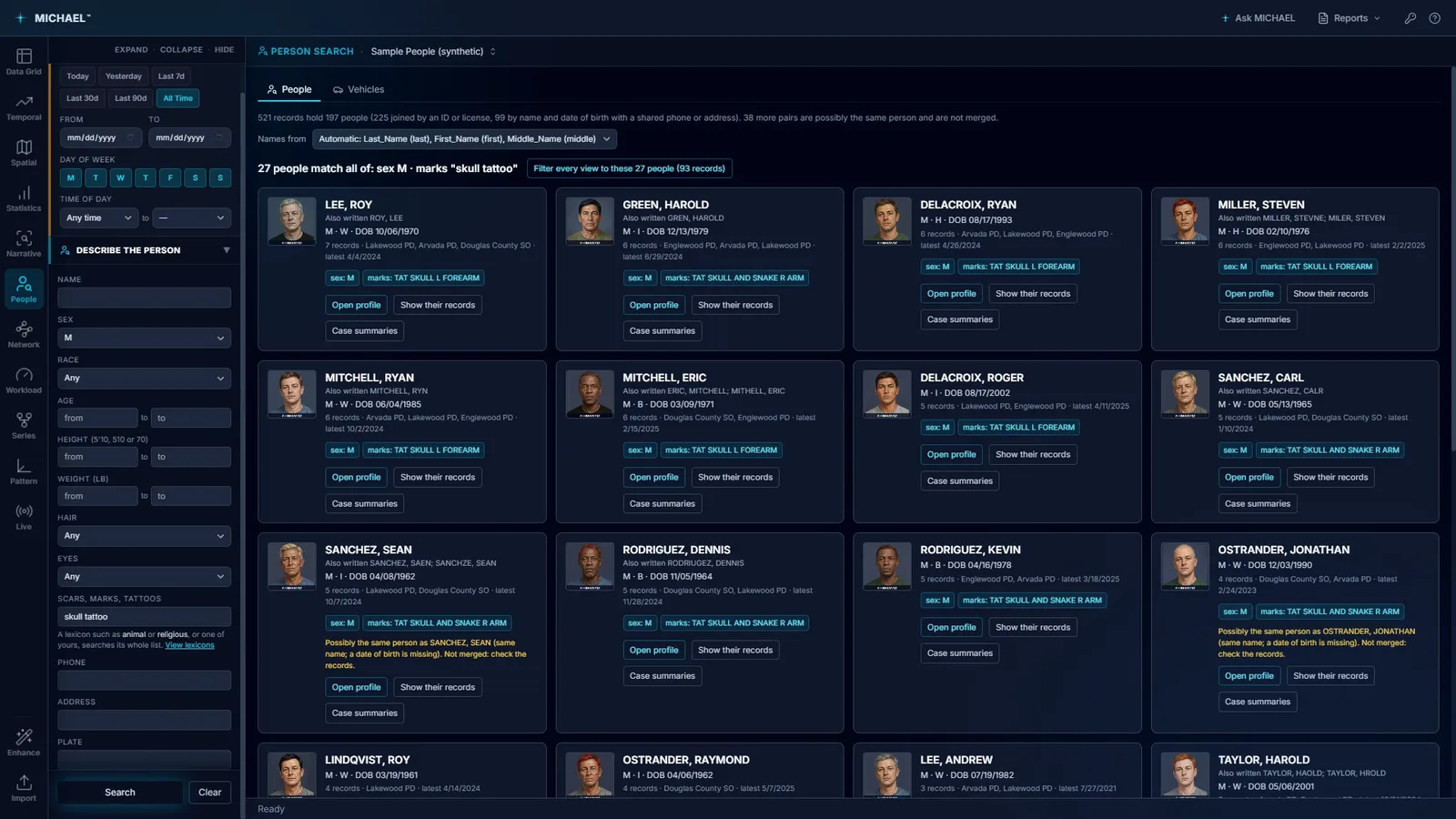
27 people matching sex M and a skull tattoo, out of 521 records holding 197 people. Synthetic sample data throughout; every photograph here is AI-generated and watermarked as such in the application.
The witness gave you a build, a tattoo and half a plate.
That is the ordinary case. A records system that needs a name or a case number cannot answer it at all, so the search happens by eye, across spreadsheets, and usually gets abandoned.
- 01Every descriptive field at once. Sex, race, an age range, a height range, a weight range, hair, eyes, phone, address. Fill in what you were given and leave the rest empty.
- 02Scars, marks and tattoos read as text, with lexicons. Type skull tattoo and it finds the records that say it, however they say it. A lexicon such as animal or religious searches its whole list at once, and you can write your own.
- 03It says what is not in this table. Search on a field your extract does not carry and it tells you, rather than returning nothing and letting you conclude there are no matches.
- 04The result is a working set, not a dead end. Filter every view to these people hands the matches to the map, the charts, the statistics and the network graph. Back to People returns you to the results and the profile you had open, and takes the filter off again.
Two records that might be one person stay two records, and say so.
Identity resolution is where this kind of tool does its quiet damage. Merge too eagerly and you have built one person out of two, with one person's history attached to the other's name, and nothing on screen admitting it happened.
- 01It tells you how it joined them, and on what. On the sample: 521 records hold 197 people, 225 joined by an ID or a license number, 99 by name and date of birth with a shared phone or address. The counts and the basis are both on screen, above the results.
- 02Ambiguous pairs are flagged, not merged. "38 more pairs are possibly the same person and are not merged." On the card itself: Possibly the same person as SANCHEZ, SEAN (same name; a date of birth is missing). Not merged: check the records. It names the person, the reason and what is missing, then hands the decision to you.
- 03Names are kept as every system wrote them. A card shows "Also written MITCHELL, RYN; MITHELL, RYAN" rather than picking a winner, so a misspelling in one agency's export stays visible instead of being silently corrected into someone else.
- 04You choose how names are read. Last, first, middle or any other order your export uses, set once at the top.
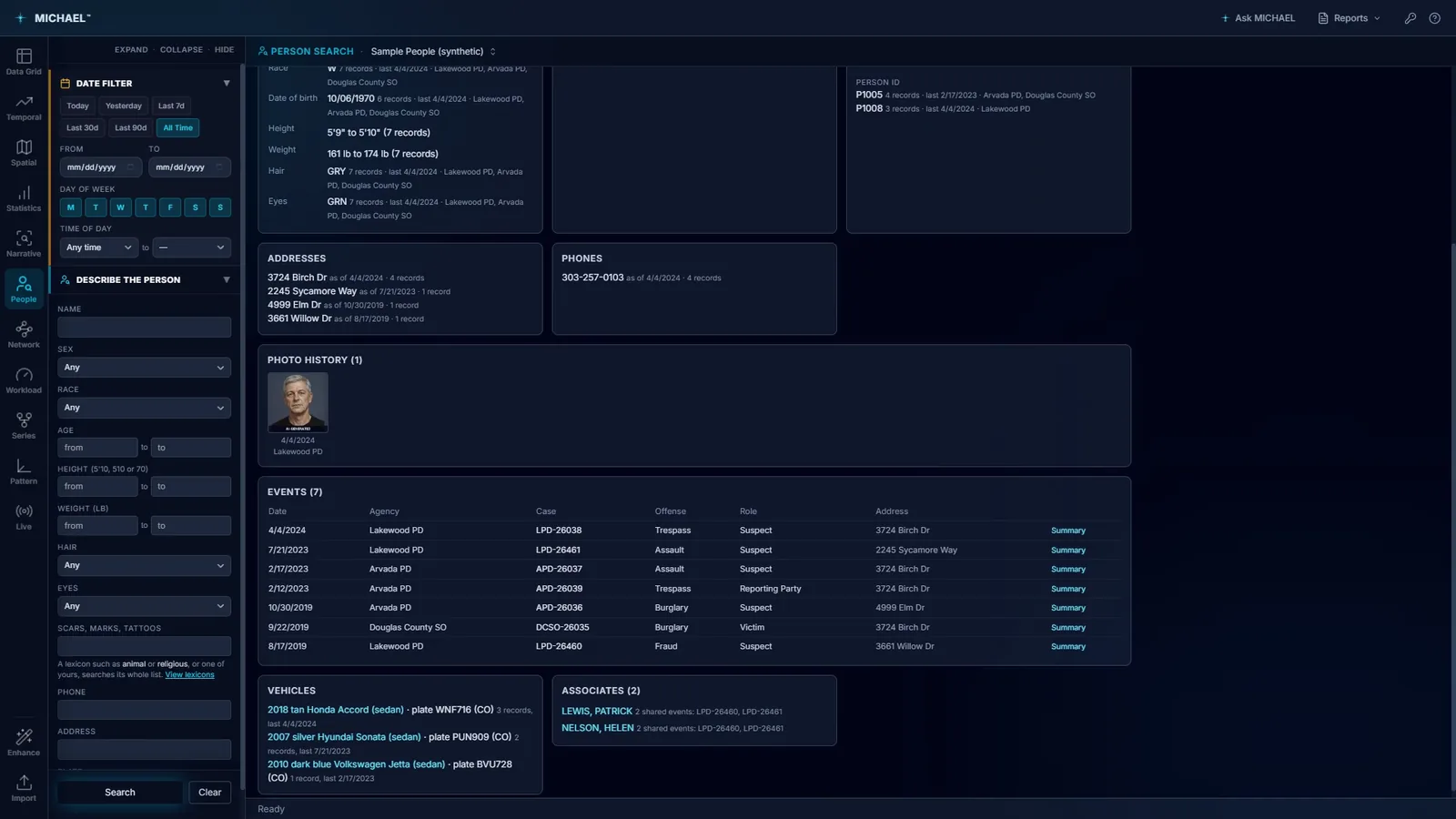
Each described value carries how many records agree on it and which agencies reported it. Synthetic sample data; the photograph is AI-generated and watermarked in the application.
Suspect in one case, victim in another, reporting party in a third.
A person's record set is not a list of offenses. It is a list of appearances, and the role matters as much as the offense. The profile keeps them apart.
- 01Every event with its role. Date, agency, case number, offense, role and address, in one table. The same person reads as Suspect, Victim and Reporting Party across different rows, which is the ordinary pattern and the one a summary count destroys.
- 02Described values carry their support. Height "5'9" to 5'10" (7 records)", hair "GRY, 7 records", each naming the agencies that reported it. A description that disagrees across records shows the disagreement rather than averaging it away.
- 03Addresses and phones with dates. Each one with how many records carry it and when it was last seen, so the current one is obvious and the old ones are still there.
- 04Vehicles and associates. The vehicles tied to them with plates and record counts, and the people who appear in the same events, each with how many events they share.
- 05Photo history. Every photo the records hold, with the date and the agency on each one, rather than one current picture with no provenance.
Half a plate, a color and a body style is a searchable description.
Same engine, same honesty about what it joined. Vehicles get their own tab, their own resolution and their own profile.
- 01Partial plates. Enter the characters you have, with wildcards, plus the state. Make, model, color, body style, a year range and any part of a VIN narrow it further.
- 02Make and color read loosely. Chevy, CHEV and Chevrolet are the same search, because your records contain all three.
- 03The same merge honesty. On the sample: 521 records hold 80 vehicles, 21 joined by a VIN and 97 by plate and state, with 2 more pairs possibly the same vehicle and not merged.
- 04Tied back to people and records. Each vehicle names the people associated with it, and Show its records hands them to every view.
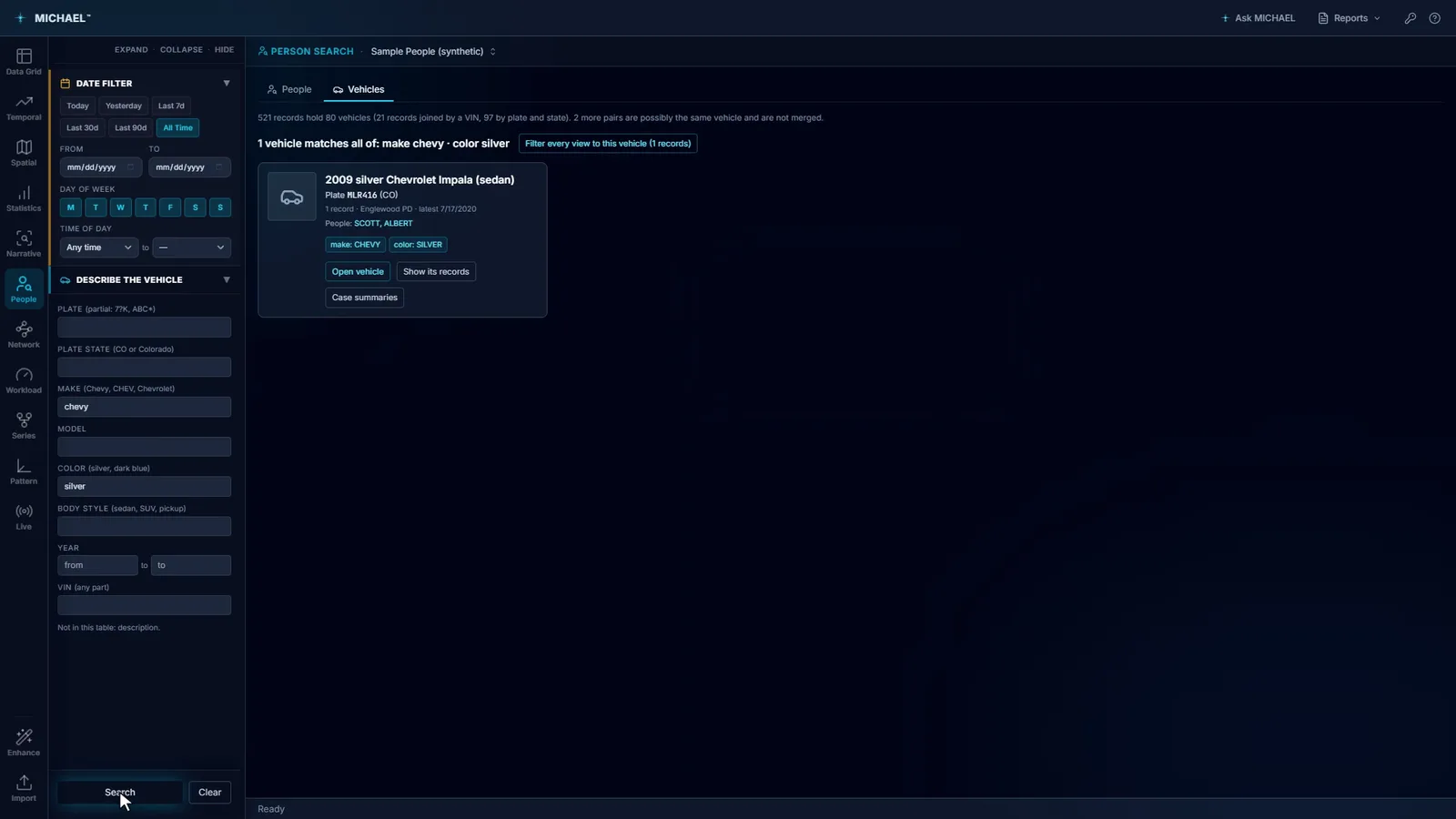
Make and color entered loosely, one vehicle matching. The panel notes which fields this table does not carry. Synthetic sample data.
It searches your records. It does not identify anybody.
This is a search over what your agency already wrote down, and that is the whole of it. It is worth being plain about the boundaries, because this is the view where a reader is most likely to assume otherwise.
- 01No face recognition, and no biometrics of any kind. Photographs are shown because your records hold them. Nothing is measured from a face, nothing is matched against a face, and no face template is created, stored or compared.
- 02No outside data sources. It searches the dataset you loaded. There is no commercial people-search database behind it, no social media, and no other agency's records unless you imported them yourself.
- 03A match is a records match. Two people in your county can share a build and a skull tattoo. The result is a list to work through, and the records behind each one are a click away for exactly that reason.
- 04No score becomes a person. There is no threat score, no risk rating, no ranking of people by dangerousness, and no watch list.
Try it on your own data.
Fourteen days, every feature, on one machine. Tell us who you are and we will email you your own download link. Nothing to activate. Your data stays on your machine and stays yours when the trial ends. No newsletter, no drip sequence.
Built for the people who do the work Sworn agencies, crime analysis units, public safety partners, and corporate investigation teams. Workstations are $2,500 a year, everything included. Academia and nonprofits: ask about license pricing.
Or email info@sworn.ai. A person answers.