 MICHAEL
 · AI analyst
An analyst's assistant with your data in front of it.
Not a chatbot bolted to the side. The model sees a profile of the records you are looking at and answers about those records, not about crime in general. When the answer needs arithmetic, MICHAEL does the arithmetic on your computer and the model gets the number.
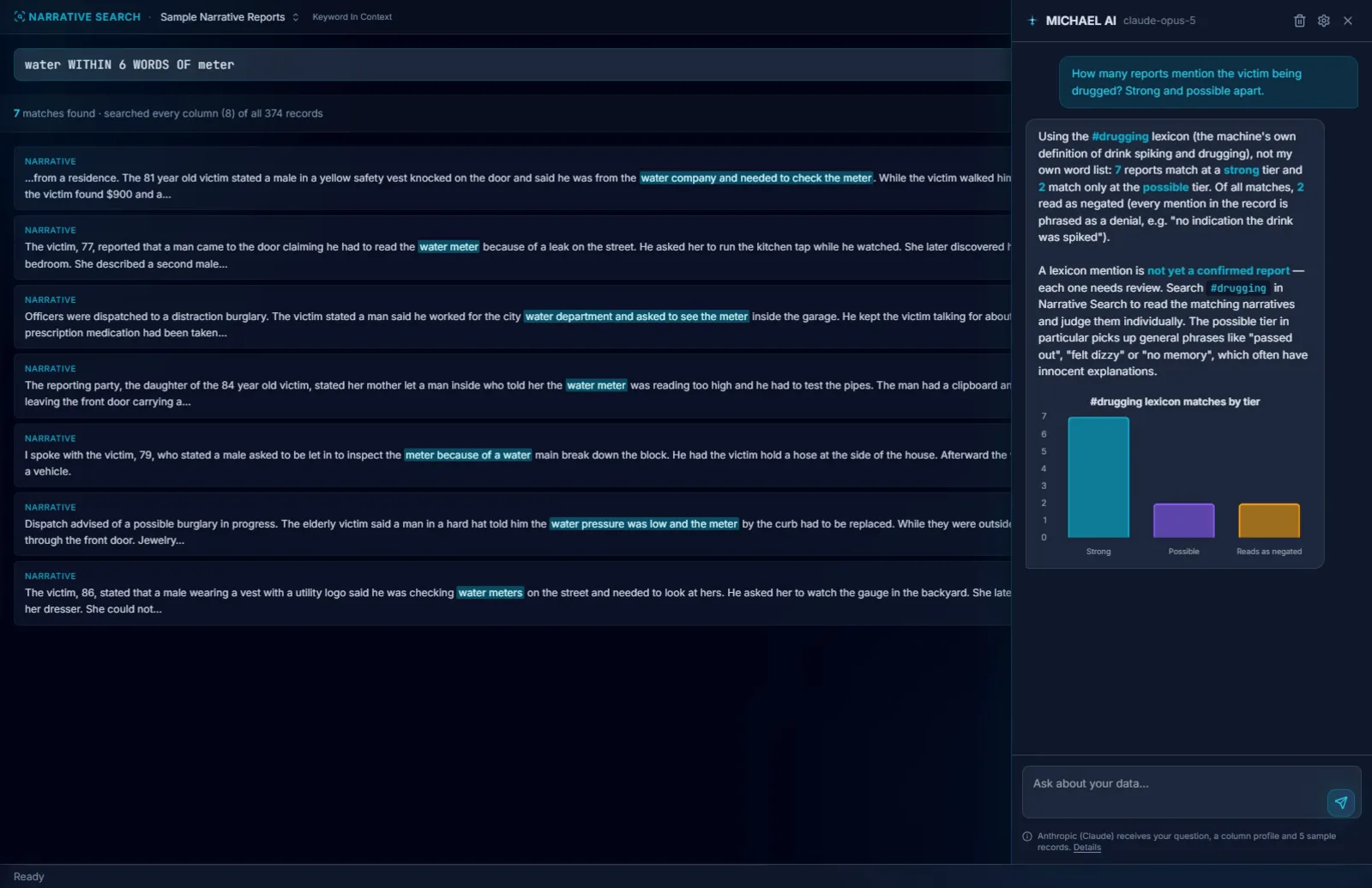
It writes the math. MICHAEL runs it, here.
A question about your records is usually a calculation in disguise. The model writes the calculation, MICHAEL runs it on this computer against the loaded records, and the number in the answer is the number the calculation produced.
- 01The number comes straight from the calculation. The figures in the answer are filled in from the result, and the answer reads (not computed) when there is nothing to fill them with. A sentence can no longer read "roughly 62" over a count of 84.
- 02It builds charts and filters. Ask to see something and the answer arrives with a chart, or with a filter you apply to the grid in one click: a dragon tattoo, or any animal, across every record.
- 03It uses your lexicons. Ask how many reports mention the victim being drugged and it counts with #drugging, or your own lexicon, strong and possible apart, instead of inventing a word list.
- 04It explains any result in plain sentences, about what you are looking at: a grid narrowed to 53 robberies gets an answer about those 53, and the answer says which filter narrowed it.
Your key, your account, your terms.
The AI analyst is off until you turn it on, with an Anthropic API key you supply or your agency's own Azure OpenAI endpoint. There is no MICHAEL server in the path.
- 01Direct to the provider, on your account. Retention and training are settings on the account your key belongs to, including a zero-retention arrangement if your agency has one. Choose Azure OpenAI and the request stays inside your own tenant.
- 02It says what it sends, where you type. Your question, a profile of the columns in view, and five of the records, so the model sees real values rather than guessing at them. A filter narrows all of it. The rest of your dataset never leaves.
- 03Your key turns it on. Every other feature works without one. If your agency's policy prohibits sending case data to a third-party service, do not enter a key, and nothing else changes.
It reads your records. You make the call.
The drawer is the one feature in MICHAEL that transmits records, so its limits are stated where the decision gets made.
- 01A count is a starting point for reading. The drawer says so itself when it counts with a lexicon. Each mention needs reading, and Narrative Search is where that happens.
- 02An answer is an estimate from the data you loaded, carrying its gaps. It exists to direct a trained analyst's attention, and nothing in it should be acted on against any individual without independent verification.
- 03What happens after the request arrives is between your agency and the provider. MICHAEL states what it transmits and leaves the provider's terms to the provider.
Try it on your own data.
Fourteen days, every feature, on one machine. Tell us who you are and we will email you your own download link. Nothing to activate. Your data stays on your machine and stays yours when the trial ends. No newsletter, no drip sequence.
Built for the people who do the work Sworn agencies, crime analysis units, public safety partners, and corporate investigation teams. Workstations are $2,500 a year, everything included. Academia and nonprofits: ask about license pricing.
Or email info@sworn.ai. A person answers.