 MICHAEL
 · Narrative search
Search the narrative for the MO.
The method of entry, the threat, the drink that was spiked: most of what an analyst needs is in the narrative and in no field at all. MICHAEL searches the free text the way an officer wrote it, words near other words, or one name for every wording of the same thing. Then it reviews, counts, and writes the answer into a column you can sort.
Find the sentence that matters.
A plain search for "knife" returns every report that mentions one, including the ones where it was in a kitchen drawer. Proximity search asks for the knife near the threat, inside the sentence the officer wrote, and shows each match in context so you can read it without opening the report.
- 01WITHIN N WORDS OF.
kicked WITHIN 5 WORDS OF doorfinds "kicked in the rear door" and leaves alone the report where a door was mentioned three paragraphs after someone was kicked. AddAND SEPARATED BY 0 WORDSwhen the two words have to touch. - 02BUT NOT.
... BUT NOT firearmdrops any record that mentions a firearm anywhere in what was searched, so a knife query stays a knife query. - 03Regular expressions, for the people who write them. Any valid pattern runs as a query, and Test Expression runs a query against a pasted sample sentence so you can prove it does what you think before you trust its results.
- 04It follows your filters. Set a date range or filter the grid to one offense and the search reads just those records, and Filter Grid to Matches sends the hits to the map, the charts and every other view.
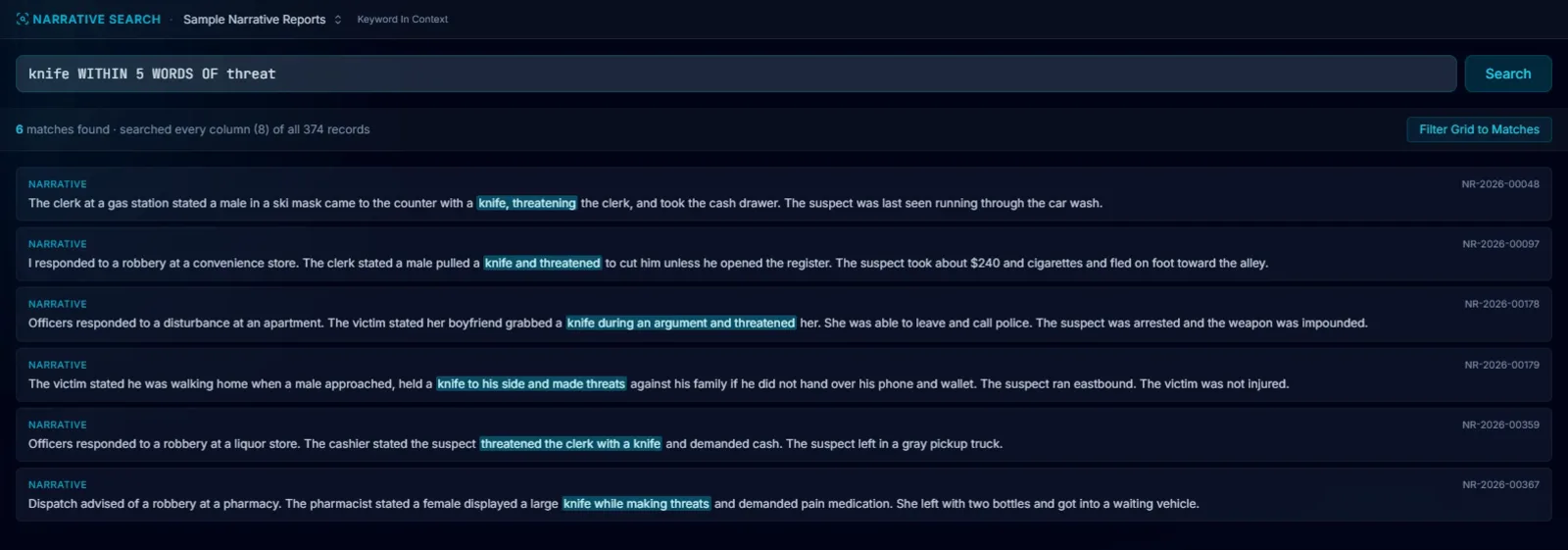
knife WITHIN 5 WORDS OF threat on the sample reports: six matches, each a threat made with a knife, the matched span highlighted in the officer's own sentence. The reports that mention a knife in a kitchen drawer never appear. Sample narrative reports.One name for a hundred wordings.
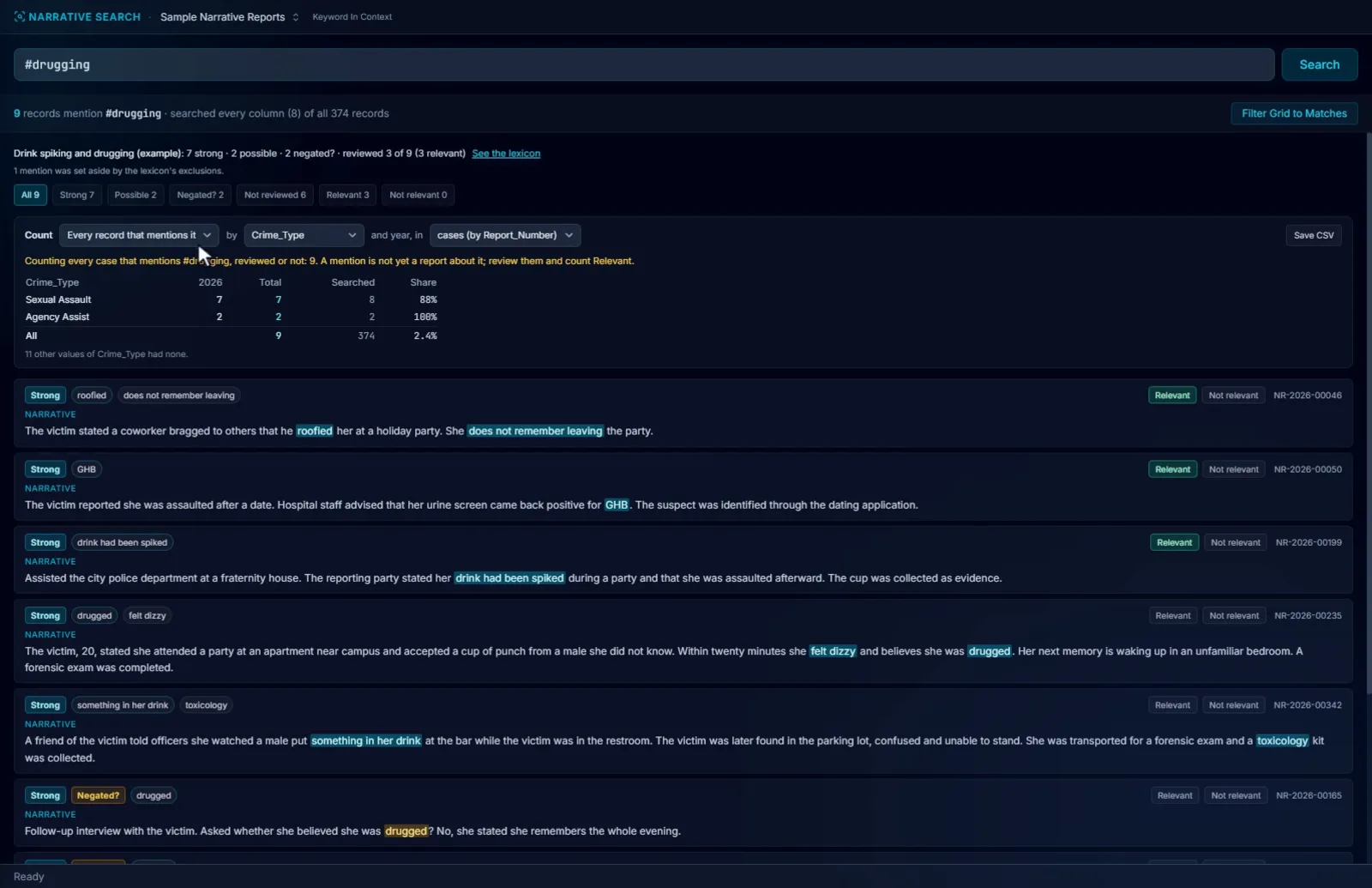
How many sexual assault reports mention the victim being drugged? The reports say it a hundred ways: drugged, roofied, GHB, something in her drink, does not remember leaving. A lexicon is one name for all of them. Type #drugging and MICHAEL searches every wording on the list, and each record says which one it matched.
- 01Strong or Possible. An entry is marked Strong when it says it outright (drugged) and Possible when it is worth reading (blacked out, does not remember what happened). The results count the two apart, and you can show either.
- 02Negated?, kept in view. A mention sitting just after "no", "not", "denied" or "never", or a question answered no, is flagged rather than removed. "Asked whether she believed she was drugged? No" stays in front of you with the flag on it.
- 03Exclusions. A mention inside a phrase you list (drugged driving, laced up) is set aside and counted, never searched. The results say how many were set aside.
- 04Review, then count. Mark each result Relevant or Not relevant. The count breaks the records down by any field and by year, says in words whether it is counting every mention or only what you reviewed, and saves as CSV. The number you report is the reviewed one.
- 05The example that ships. #drugging comes with the app as an editable example, checked on one agency's 83,858 crime summaries. Copy it and it is yours. The sample reports include a case where drugging is denied and a drugged-driving report the lexicon correctly sets aside.
Write your own, and watch it work before you keep it.
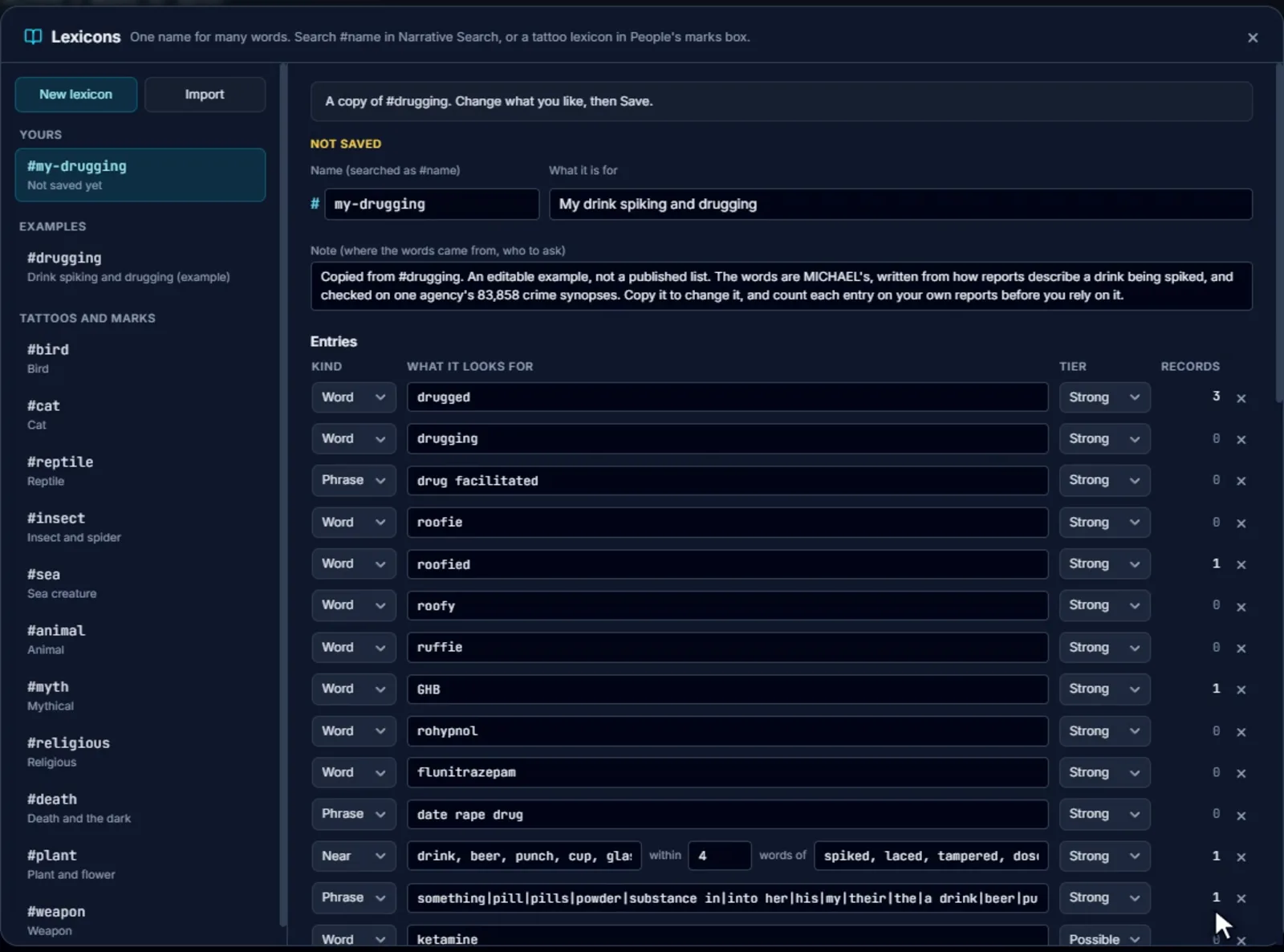
A lexicon is a list, and the list is yours. The Lexicon Library holds yours, the examples and the tattoo lexicons, and every entry you type is counted against the table you have open while you type it.
- 01Words, phrases, word pairs, or a pattern. A word matched whole or plural, a phrase in order inside one sentence, two lists within so many words of each other, or a pattern for those who write them.
- 02A count beside every entry. How many records in the open table each one matches, so a word that floods is obvious at once, and so is one that finds nothing.
- 03Find words. Type part of a word and MICHAEL lists every spelling in your reports that contains it, with how many records carry each, so the misspelling nobody would think to type turns up. Click one to add it.
- 04Let the AI suggest. Describe what the lexicon is for ("drug-facilitated sexual assault") and press Suggest. It proposes the words, phrases and word pairs the way officers write them, slang and misspellings included, each counted on your table before you decide. Nothing is added until you tick it.
- 05Share it. A lexicon exports as a small file a colleague or another agency can import. It holds the words and the note on where they came from, and no records.
Fill a column from the narratives, and read every row before it changes.
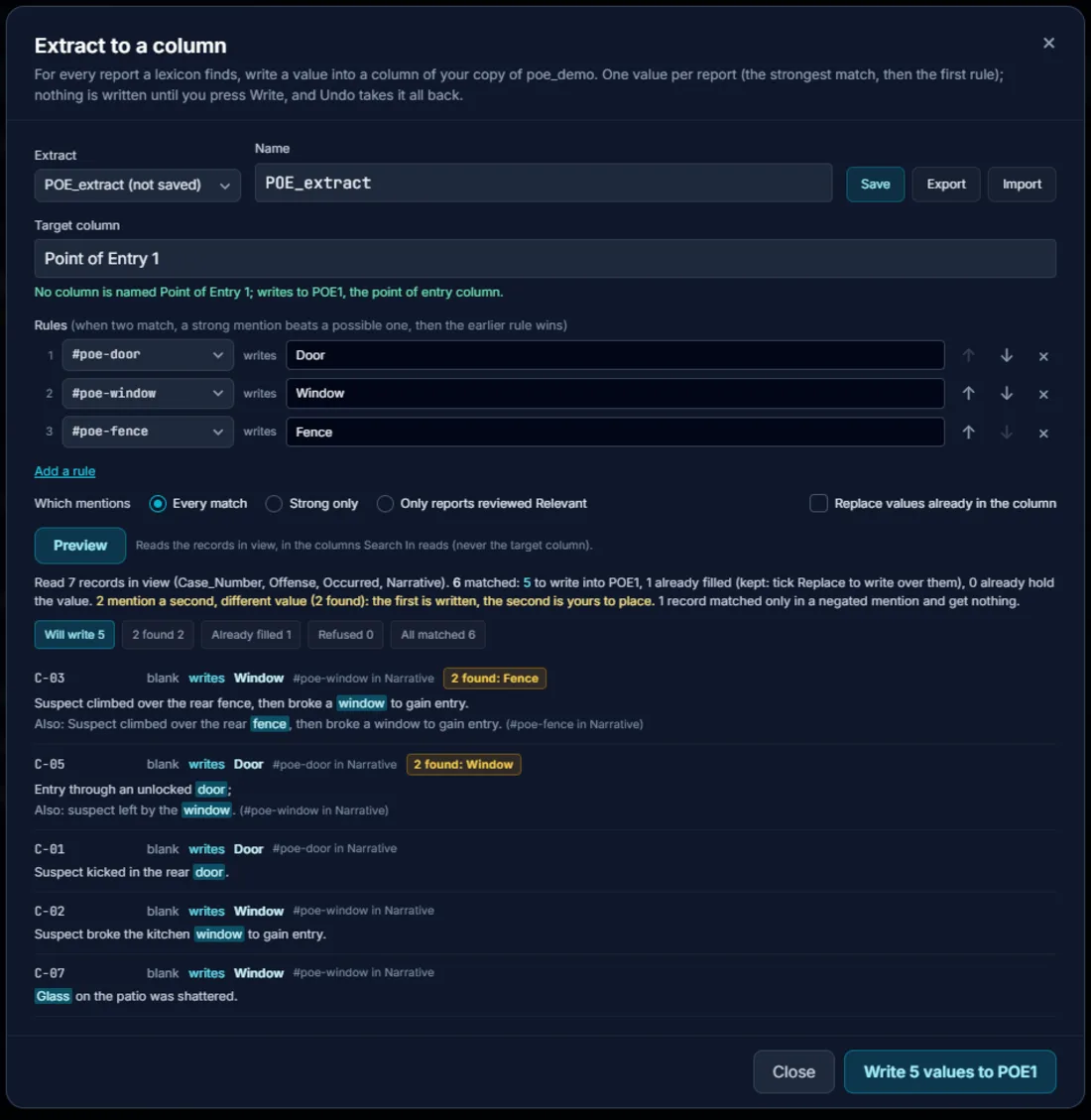
Point of Entry sits empty on most of the reports that describe it. An extract is a set of rules, each a lexicon and the value it writes: #poe-door writes Door, #poe-window writes Window, into a column such as Point of Entry 1.
- 01Preview first. Every record it would touch, with what the column holds now, what it would hold, and the sentence that matched. Nothing is written until you press Write.
- 02One value per report. A strong mention beats a possible one, then the first rule in your list wins. A report that also mentions a second, different value is marked 2 found with both sentences, so you place that one yourself rather than having it guessed.
- 03What it writes, and when. A negated mention (no damage to the door) is never written, and the column being filled is never read as a narrative. Choose every match, strong mentions only, or only reports you reviewed as Relevant; empty cells only, unless you tick Replace.
- 04Written as edits, and saved by name. The values are marked in the grid, one Undo takes the whole extraction back, and an extract saved as POE_extract runs on the next dataset or travels to a colleague as a file.
Ten extracts, each with its score printed in its note.
Press MO pack and ten ready-made extracts arrive with the lexicons they use: point of entry, side of entry, method of entry, suspect actions against property and against persons, weapon, property taken, and vehicle make, color and style.
- 01Measured before it shipped. Each was run on 21,611 real burglary and robbery reports and compared with the analysts' own coding of the same reports.
- 02What it scored. On buildings, the point of entry it writes matched the analysts' three times in four. Method of entry, 56 percent. When it names a weapon, the analysts coded the same kind 58 percent of the time.
- 03Yours once added. Preview before you write, and change any word to fit how your agency writes its reports. Every lexicon's note says how it scored, so you know which to trust before you run it.
It reads what officers wrote, carefully.
Narrative search is a reading aid for people who have more reports than hours. Its limits are a careful reader's limits, and the panel states most of them on screen.
- 01A match is a mention to read. Strong means the words said it outright. It does not mean it happened, which is why Relevant and Not relevant sit on every result and the reviewed count is the one to report.
- 02It finds what officers wrote down. A report that never mentions the door cannot yield a point of entry, and a count of mentions is a count of how officers write as much as of what occurred. Count each entry against your own reports before you rely on it. The example lexicon's note tells you the same thing.
- 03A lexicon is a list you can read. It matches the words on it, whole words, and nothing else. That is the point: you can read the list, and so can anyone who asks how you got the number.
- 04The words on the list do the searching. The one model on this page proposes words from a description you typed. Searching, counting and writing a column are done by the words on the list, on your machine. The AI analyst that can count with your lexicons is a separate feature you switch on, described on the main page.
Try it on your own data.
Fourteen days, every feature, on one machine. Tell us who you are and we will email you your own download link. Nothing to activate. Your data stays on your machine and stays yours when the trial ends. No newsletter, no drip sequence.
Built for the people who do the work Sworn agencies, crime analysis units, public safety partners, and corporate investigation teams. Workstations are $2,500 a year, everything included. Academia and nonprofits: ask about license pricing.
Or email info@sworn.ai. A person answers.